Showing posts with label introspection. Show all posts

Monday, September 30, 2013

AZURE'13 : Winner entry 2

THE PERPETUAL ENIGMA OF CHANGE


Time rolled by. Maintaining a polite masquerade of innocence, it has subtly been chipping its way through without respite; reworking and reshaping everything that came its way, with no exceptions whatsoever. Whether they happened to be my aspirations, likes or dislikes, my hopes, priorities or the choices I made, the circumstances I've had to face, or the people around me, everything has just been in thrall, right from the very beginning. A victim, in this mute memoir that life itself has been reciting all along and always will, till the end of time. And behind the self created and self imposed bars of routine confinement, within this flowing time, we rarely realize how much we miss every day, with every passing second of our lives. And it's really not until you take a step back, and take cognizance of who you were and who you've become along the way. 'You've changed so much' --is probably the biggest cliché, when it comes to social gatherings, and for me this has always fuelled introspection, and helped me glance back at my antecedents to get a better understanding of whether this change extends beyond just the physical demarcations.


When you see someone your age, with an unusual dexterity or some distinctive attribute that makes him/her unparalleled in that field, whether it's an artist or a famous author, an orator or a poet or maybe someone with a great physique, the very first thing that we consciously register is their deviation from the regular normalcy. And, in the process of trying to figure out what could've caused this contrasting difference, is where our prudence fails. Because we simply fail to grasp the very fundamental law that governs this final outcome.
I believe that every saint and fiend who've ever existed, always have had one thing in common, they were born alike. It was the course of seemingly inconsequential events they had to endure throughout their lives, which wired them into who they are, and that’s what makes us look at them as two different beings. Yes, we might have had some innate predilections when we were young, which might have given us an edge over others in some areas, but the very base that we start off with has always been exactly the same for each and every one of us. An intricate statue carved out of a stodgy piece of rock was always there. It was just what was chipped out, that makes it look like the way it is. It's really what we 'leave' behind through the course of time, that decides what we end up having at the end.
It's what is taught to us, what we invest in, what we aspire to be like, what we've had to face in our lives, that makes our paths so different. And once you reach a point, where you fully understand what it takes for a change to happen for betterment. And that the change you want to see is really up to you. Once you understand, that not everybody will join you, that not everybody will have the vision, and that even if no one else sees it for you, you must see it for yourself. When you go beyond the fear of failure, and start investing in yourself; you would witness, the true magnitude of your potential. When you are willing at any moment of time, to sacrifice what you are, for what you will become, you would eventually understand that you don't have to go through your life being a victim. When you strive to become an individual; when you struggle to become the person you were created to be; when you 'define' the change you want to see and your belief resonates with the possibility of this change,  you start living a life where changes happen for a reason, a life where things are not just on auto pilot; a life where 'you're' running the day, the day's not running you. That would be the kind of change that I seek.
But the story takes a sudden precipitous fall, when you get caught up in the daily hiccups of life and succumb to your circumstances, 'before' reaching that threshold of maturity, where you can truly appreciate your raw potentials and your mind's own infinite nature. I believe, everyone of us was given a 'lorry' when we came to this world, a means to fling past the tough times that we were to face, through the journeys ahead of us. But, just like any two leaves of a tree, no two lorries were the same. Some could move swiftly while there were others, which hardly moved at all. Drowning in a sense of lack, unhappiness and bias, the unfortunate ones struggled. Inch by inch they dragged their lorries, as the others swooshed past them. They were rendered autodidacts, left alone in their cosmos of sufferings. Some had the luxury of the right guidance and were strong enough to reach up to the threshold and take control of their lives, and be the change they wanted to see in the world. While the others, unaware of their true potentials, sought for easier means to make their lives less painful, ways which were not always right.
Every noble, thief or a delinquent, every face that there is to see, has a story to tell of the path of changes that it has undergone. When a murderer is killed, for the greater good of the society, when you are left with no choice, but to take away the life of the living, you destroy more than just a person who did wrong. I think, somewhere along the line, you kill a soul that never found the right lorry, and that is a failure on 'our' part. You teach something to live a certain way all its life, and when you hit a dead end, you kill it for what it has become for you simply don't know what to do with it anymore. I don't think you cure the disease by killing the diseased. The cure lies deep within, the cure lies in understanding the problem first. If there's water leaking in your house, you don't just keep clearing water off the floor, you fix the damn pipe. We look at the result, the outcome, because that is the easiest to see and judge, instead of understanding the 'reason' behind the change and killing the 'cause'. And so in this war of good and evil, to seek justice, I believe, it's actually the humanity that looses every time.


 It's not where you start or where you finish in life, it's the distance that you travel that really matters. When you see someone who overcame the odds and 'changed' his life for betterment, stop; put your hands together for him; give credit where it's due; remember the name of that person, for one day he might be an inspiration for someone doubting himself; someday he might be an inspiration for 'you'. Yes, it’s hard to change your life, but it's necessary to know that tough times have not come to stay, they have come to pass. Lend a helping hand to someone who needs it. Show them that they have the strength to overcome whatever that is they're facing. Make them smile and let them know that you care. I guess, there is no one variable to the equation of change. We make new variables as we go along. Change is inevitable. But to make this change count, we need to understand that we are an uncommon breed with unimaginable potentials. And we'll never know the limit of our possibilities until we charter the waters of the 'impossible'.


Anandbir Singh BainsMechanical, 3rd year

Tuesday, May 28, 2013

JAAGO


When will India take charge of India?!!!


We have been sitting in our armchairs for too long .We have complained about corruption, debated about poverty, ranted about overpopulation. But, when has an armchair sparked change?

We are arrived with the resources and expertise. What we need is the initiative. And, once we stand up, we can turn India around. One problem  at a time, because isn’t “charge” one letter away from “change”?

It has come –do we want early elections or not? Well, the answer may differ person to person, but an inevitable truth is we want somebody; rather everybody to take CHARGE. Get up and do it –this call of the hour.

When will we grow up? Enough has been said and told to us-about the right and wrong, about the cheats and cheater, about scams, about our so called “LEADERS”; about the whole of India.

CHANGE.  CHANCE. CHARGE.

Change is what we Indians want; chance is what mostly politicians grab with our help and charge is something which is left behind in the portfolio!! Learn to take responsibilities and get your responsibilities clear- its not just to vote and wash your hands off after voting....this is just a part of our duty. The actual one is to know and scrutinize the candidate to vote for. The responsibility does not end here-you need to take the sword and become warrior if you don’t see change happening.

Don’t  become a part of India , be it. We have seen few people who got up and fought for their place and today those places have flourished. India should not just breathe, it should live! Get out of your rosy and cosy life and pick up the sword. Corruption and poverty are indeed having deeps roots but you can rule the skies and with it clear the system. Fight for your country, with your country and release it from vicious clutches. Release it.
No one shall cause another pain or injury;
All mankind shall live in peace together;
Under a shield of  administrative  benevolence.
Let us build an India.

Don’t sit in the group waiting. Raise your head, put up your hand and turn a war cry that could change the course of history. You can turn hope into conviction, anger into purpose and cynics into converts. Today our nation stagnates. Under  the dark shadows of a billion fingers pointing at one another , shouting about what should be done, how it should be done and who should do it. We don’t need any more finger-pointers. We have enough. We just need a few who will put up their hand and say I WILL. It’s the time the real India stand up. Never believe that a few caring people can’t change the world. As a matter of fact, that’s all who ever have.
  
VERTIKA AGARWAL
Creative Team
IBC

Tuesday, May 21, 2013

From A Million Hearts To A Billion Wallets


Mahatma Gandhi- The Father of the Nation. 


The nation that we call India, lets stick to this only because calling it Bharat does not really help our cause. Some random thoughts began brewing in my mind as I took a hundred rupee note out of my pocket and handed it to the worker who knows me well and has been working in this ice-cream shop for some time. No, I don't even know his name, but a "Bhaiya" is more than sufficient to get my order placed quickly.


For some reasons, Gandhiji's photo has decreased in both its affluence and influence and has been limited to currency notes only. In primary classes there are essays that students have to mug and replicate in their exam copies. A nice holiday on 2nd October is always welcomed. A couple on minutes of silence on 30th January, well that gives a nice break from all the commotion around, doesn't it. A framed picture on the walls in government offices, with an inch-thick layer of dust. Yes he is still the father of our nation but the peon does not bother to wipe the dust now. The people do not remember him on days other than these two of course. Yet their was a time when this now forgotten man walked on the face of the earth, right where the British were on the peak of their atrocities and lead an entire country to freedom without even raising a stick. But then, Bharat turned into India, we came civilized and modern, Gandhism turned into Gandhigiri and all the noble deeds of this man ended up in our pockets, with his bespectacled face in our wallets.

However one would contradict with me in some regards, what with Anna Hazare and his revolution. His method, his fasting and the lathicharge on protesters in Delhi. For a moment, even for a bleak one, it felt as though the times had reversed- a nation going head-on against the incumbent government without any act of violence. But it did not last for the Jan Lokpal Bill is still under "consideration". The very root of the problem that it intended to cut off- corruption, has grown in its domain day by day. The movement which began as protest has turned into a political party, deprived of support and muscle. But what was it that really made the difference back then, during the struggle for independence, because the principals are more or less the same- but why are they ineffective in the present context?

I think we can narrow it down to a couple of simple facts. Firstly it was the man himself- Mohandas Karamchand Gandhi, for his charisma and intensity is yet unmatched. Perhaps it was far more convenient to forget the man, rather than following his principles he stood for. The social values and beliefs he stood for were and always will be easier to admire than to follow. While he was alive, he was impossible to ignore- the British tried to at their demise. And once when he was gone, he was impossible to imitate- which is quite apparent in the present scenario. Apart from this, the other thing which drove his engine forward was his pursuit of Truth. Truth with a capital T. For he believed in the the fact that if you are correct, and the Truth is on your side nothing can hold you back. Truth cannot be attained by unjust or violent means. For he said, "Even if you are a minority of one, the truth is the truth." Such was his deep-lying belief in this philosophy. Its hard to break resistance of able bodied men, but for a man whose spirit is as indomitable as his, it was next to impossible.  

Secondly, and maybe this one holds the edge, it was the people who made Mohandas Karamchand Gandhi into Mahatma Gandhi- and not just in name. He was their leader, their saint walking in front of their eyes.They followed him and he lead them towards truth, towards light, towards freedom. Had they absconded his pursuit in the middle of this epic struggle, things could have shaped up very differently indeed. Those people did not sit back in their homes, waiting for things to happen. They did not flock to the cyberspace to extend their support via innumerable "shares" and "comments" on virtual "walls". They stepped out and wrote "Inqualab Zindabaad" with their blood on the walls of jails inside which they were beaten down to pulp. They did not walk away when the police drew lathis on a a couple of girls in Punjab. They did not walk away with indifference when a group of young men protested on the main square of the city. They stood there, abiding his command not raising their hands even once. They joined shoulders forgetting their petty differences- yes those very differences which have become the basis of communal politics.
They stood their by his side

I wonder how Gandhiji would have reacted when he would have seen what has happened to his beloved country. Maybe he would have asked for a bullet, and said "Hey Ram" (though this time in a very different sense) and put it inside his head. Probably saving another Nathuram Godse from the trouble, for he is our father, and he took this blame too upon himself.

Summer is here, I feel like an ice-cream now. The old man in my wallet needs some air too.
Bye.

Nishant Chaturvedi
Electrical
3rd Year

Sunday, May 12, 2013

‘SECONDS’ RE-LIVED


Every action of ours has a consequence. And that consequence is based on what we did, how we did act, how we did think and what path did we choose for our journey. Destiny gives back everything it ever took from us and takes back everything it gave us. Amidst all this, there is one ultimate reality which cannot be altered however we might neglect it or whatever perception we possess on the world around us. Life of an individual undergoes evolution, by being churned in the vicious circle of all these facts. And my life was no different. The day I met with an accident, was the day that changed my perception towards the world forever and ever. As soon as my car did slide off the cliff, I lost my control on the brain, besides gravity. How much time was I left with? May be 15 seconds! And in those 15 seconds, I understood many things that my 15 year education did not teach me!


  I recollected the lives of 4 persons who were an integral part of my life. 4 different ‘persons’with 4 different mentalities and I am going to introduce them to you all…


5 Year old me:
As earliest as I can remember. We were residing in one of the best colonies and childhood was a fun filled one. Gully cricket, I Spy and many more games used to carry forward our days besides the daily routine of acting out a stomach ache drama so as to escape the tedious activity of attending school. Everything was a cake walk for me.

17 Year old me:
Everything around me started making sense to me. On the alternative days, my mother and father used to sleep on the floor to make enough space for me on the bed. In a locality where people stand for ten hours in front of a shop for the ration, my parents made me feel like we were in a heaven! Sacrifices made by them and struggles taken by them were like a thick carpet spread over on the path of thorns. That was the moment when I decided that struggles would be my back pack from now on and I would never let them down. My vision was clear, I decided that I shall not leave any loose strings in achieving my dream of clearing the civils and I sacrificed my social life entirely from then on.

24 year old me:
Became the first person from my locality to clear the civils and the environment was festive all over the colony. The first thing I wanted to do is to improve (provide!) the basic facilities of my society. But my posting was done in a far away city and that came as the first disappointment to me. I had to bribe a huge amount of 1000k to re-shift my posting to my area. Our family was in huge debts then and I had to take the big risk. I know nothing is more to me than the colony I was brought up in, but not more than my parents’ comfort. They have suffered enough. As soon as my fix up my family problems I would be starting with the development of the colony.

35 year old me:
I became a successful person, responsible son and caring father. Got everything I wanted in my life. Of course drifted off my path a little by taking the bribes and approving the projects. It all started because of my cornered situation where I had to pay off all the debts and I wanted to do that soon. Started taking some low profile harmless bribes. And it continued as my desire to see my parents in a more and more comfortable position increased, until we had a duplex in one of the costliest areas of the state. And then came the responsibilities of being a husband and a father. Needed to secure their lives first and that became my primary goal. This continued as life gave me different challenges in different ages. Then one day, I did read a news on my ex-colony which I swore to develop. A kid died due to infected water, taking the tally of deaths to 13 that month. 13 deaths! That means a huge distress to 13 families! What was I doing! I ruined everything just by not holding on to my responsibility. I hardly slept that night and that’s the last thing I remember.

The colony, it’s problems, lives of it’s residents and their pleas- everything remained the same. What changed was my perception towards the life as I grew up. But does that soothe my conscience and can the reality be altered because of the change in my perception! Of course not. That’s what philosophy of life is about. And such a disappointing life is going to end within few seconds. Wait! It’s been some hours and those 15 seconds are yet to be finished and if the above mentioned thing is the last thing I remember, how the hell did I end up in sliding off a cliff! Then the car hit the ground and I opened my eyes. It’s been a ride of realisation for me. I started walking to my working room to settle the things once and for all, however hard that may be! 
Vivek Reddy 

Sunday, March 31, 2013

VOTE.SELECT.ACT


Politics is the art of influencing people on a civic or individual level. And, democracy is the relationship between people and politics.

The history of India takes us back to the individual republics of the 6th century BC, that is, the sanghas and the ganas which closely resembled a democracy. India has been following democratic rule since the year 1949. But is the system followed by our government really democratic? Is the common man being given rights the constitution claims to bestow on him? If yes, then why is politics a bad word? Why is a politician seen as some corrupt, sadistic individual who knows nothing, but thinks he knows everything?
Take the example of Rahul Gandhi who is being considered for the prime minister’s post by the Congress. After almost three generations, we think that the Gandhis might give it a rest. But, no, they just have to run a monarchy in disguise. Our constitution boasts about the right to equality, however, it was flushed down the drain long ago when it became a ritual for rape victims to wait for a decade to get justice. Educational privileges and the right against exploitation are violated every time a kid is forced to beg on the streets with the notion “pity pays”. And the suicides in Gujarat due to penalising of farmers are a sorry acceptance of the “right” to life and property. Democracy in India allows us to break laws which guard these civil liberties, to name a few.

The answer to all questions lies at the root level. The bug is in each and every individual who votes and in each one of us who does not vote. It is nice to write an article on what a pathetic excuse of a democracy our country is. It is nice to blame the system for all its loopholes which fail to prevent trafficking, suicides and the growing difference between the haves and the have-nots. It is great to read such articles and reflect upon them. But, it is not nice to accept the victims of this system as our own. It is not nice to put ourselves in their shoes and stand up against the prevalent corruption as long as our needs are satisfied. And, due to some mental barriers, it is just not nice to vote with a rational mind. An empty stomach is not a good political adviser. Think about it.


SANJANA MAHABALE,
LITERARY MEMBER,
IBC

Friday, March 29, 2013

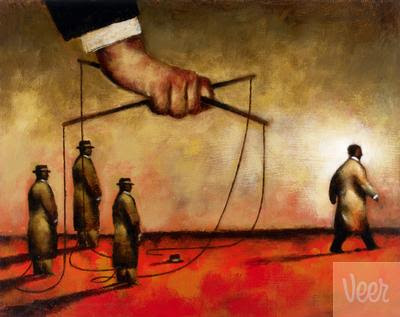
BUREAUCRAT PUPPETS


STRINGS UNATTACHED?


The dictionary meaning of a bureaucrat is: ‘An official who is rigidly devoted to the details of administrative procedure’. But do our so-called “bureaucrats” stand up to the definition of their posts? Or are they merely puppets in the hands of the political masters?
Here I have compared what German sociologist Max Weber defined a bureaucratic official as and what the definition has changed to:
·         He is personally free and appointed to his position on the basis of conduct.
versus
He is not personally free and appointed to his position on the basis of contacts.

·         He exercises the authority delegated to him in accordance with impersonal rules, and his loyalty is enlisted on behalf of the faithful execution of his official duties.
versus
He exercises the authority delegated to him in accordance with personal rules, and his loyalty is enlisted on behalf of the faithful execution of his official duties to the ruling party.

·         His appointment and job placement are dependent upon his technical qualifications.
versus
His appointment and job placement are dependent upon his social qualifications.

·         His administrative work is a full-time occupation.
versus
His administrative work is a full-time occupation when a powerful public servant needs him.

·         His work is rewarded by a regular salary and prospects of advancement in a lifetime career.
versus
His work favouring a particular party is rewarded by a regular salary and prospects of advancement in a lifetime career.

·         He must exercise his judgment and his skills, but his duty is to place these at the service of a higher authority. Ultimately he is responsible only for the impartial execution of assigned tasks and must sacrifice his personal judgment if it runs counter to his official duties.
versus
He must not exercise his judgment and his skills. Ultimately he is responsible only for the partial execution of assigned tasks and must sacrifice his official judgment if it runs counter to his personal duties.
·         Bureaucratic control is the use of rules, regulations, and formal authority to guide performance.
versus
Bureaucratic control is the use of rules, regulations, and formal authority to guide performance under specific conditions and superiors.

While narrowing down the term ‘bureaucrats’ in terms of the Indian constitution, we can count District collectors, IAS and IPS officers. As many of us are aware, to reach such designations, it requires years of dedication towards education and values. But what happens after they get into the system? 

They lose their ethics under the pressure of their puppeteers.
Every politician in the country is aware of the power and fame of any bureaucrat, and so are they themselves. But it seems that the former make a better use of this. The question is: why do they blindly follow the orders? The bureaucrats, not being unaware of their position, tend to succumb to the ill-fated wishes of Ministers, scared by the consequences of one action by a powerful politician. It can cost them their health, wealth, security, fame or family. And, their inactivity against corruption is not justified. Or, some may not be terrorized by the results on their career, and are driven by their greed.

And what does this lead to?
We may have come across this example (in reality or in fiction) where the DSP or SP states that he/she is not in a position to take an action against an MP or the CM. Do you think this is a flaw of the constitution?  Or just the cowardliness of a bureaucrat that he is unable to force constitutionally correct decisions over the corrupt ones? Any democrat has the potential to reject the dominion of corruption. But do they?
The outcome is an overall increment in the corruption levels of the system. Henceforth, any specified task cannot be efficiently completed at higher or lower levels of the government.

Another question which would arise in this scenario would be:
who is more at fault? The bureaucrats? Or their controlling politicians?
One would say, that since the flow of power is from the politicians to the bureaucrats, corrupt acts should be killed at the roots, i.e., it is the responsibility of the politicians to maintain the dynamo of the government. On the other hand, if bureaucrats do not accept such work place values, they can control it in the threshold.  But the truth remains that if one part of a system is malfunctioning, the whole system malfunctions.
What possible improvements can be made to the existing system?
Improvements can be made only when each unit (from the first person to the population) starts working for benefit of the whole, and not just personal interests.


SANJANA WADHWA,
CREATIVE HEAD,
IBC